About us
What we Believe
St. Thomas’ is an Anglican Church, rooted in the orthodox Christian faith as professed in the Ancient Creeds. Our life and worship are grounded in a strong commitment to Word and Sacrament, which stand at the heart of Anglican spirituality.
An ancient Latin phrase often used in the Church is lex orandi, lex credendi — “the law of praying is the law of believing.” In other words, what we pray in our liturgy shapes and expresses what we believe. Our worship, therefore, is not only an act of devotion, but a living expression of our faith.
Our worship is liturgical in nature, shaped by the historic patterns of the Anglican tradition, yet offered with reverence, warmth, and attentiveness to the present moment. Through scripture, prayer, preaching, and the celebration of the Eucharist, we seek to worship God faithfully and to be formed as a community of disciples
We are also a progressive parish, continually seeking new, fresh and creative ways in which we can better serve God.
St. Thomas’ is committed to hospitality, outreach (serving our neighbourhood, the city, and the world) and creative worship.
Sunday Worship at 10:30 a.m. |
Holy Eucharist (Communion) from the Book of Alternative Services (1985) (BAS)
A worship service, including hymns, worship songs, organ, worship band and choir. Family oriented with a children’s focus before children are dismissed for Sunday school classes. This service is followed by a social time at coffee hour in the parish hall. The BCP rite is used the second Sunday of the month.
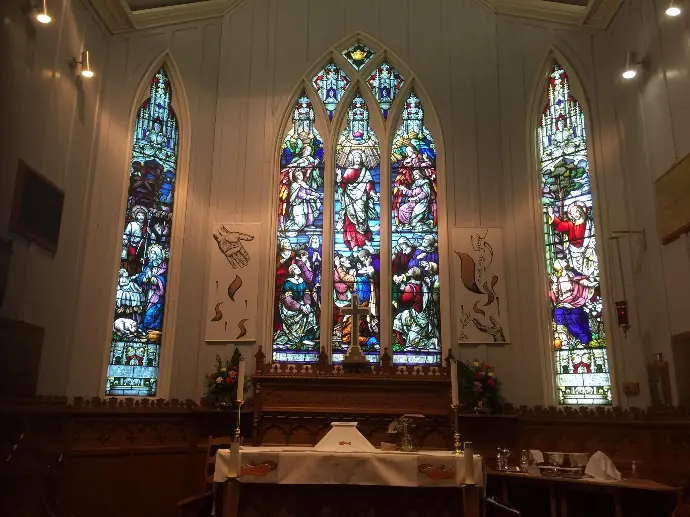
Weekday Services in the Chapel
- Tuesday Morning Prayer - 9 am
- Tuesday Prayer Time for Ladies - 7 pm
- Wednesday morning Eucharist - 10 am
Our Staff
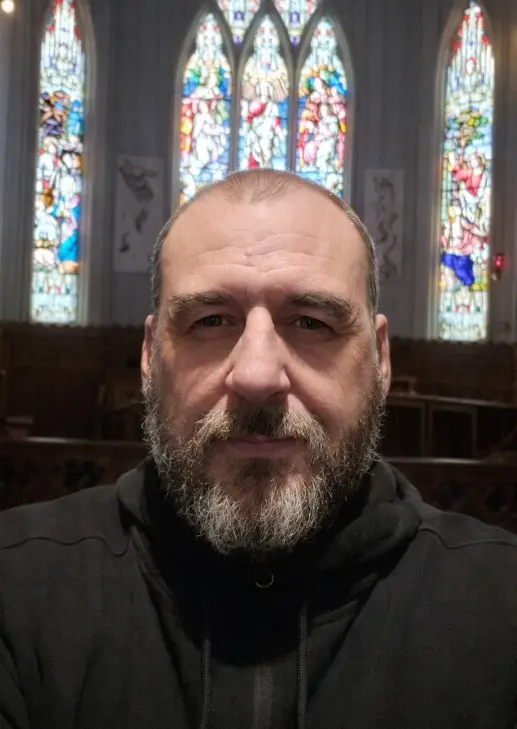
Canon Dale Careen
Rector
e-mail: [email protected]

Paulette Hounsell-Collins
Parish Administrator
e-mail: [email protected]



Our Leadership

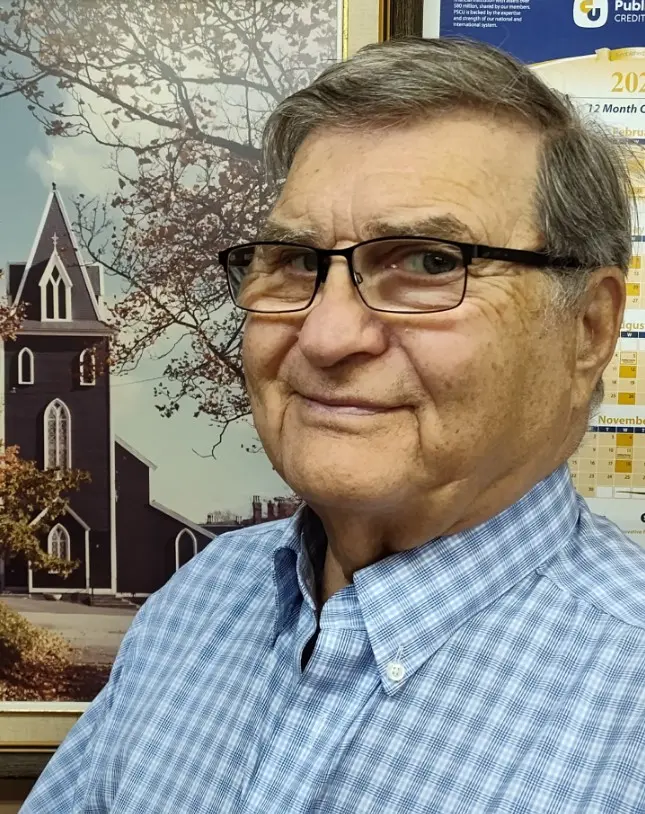
Dave Dewling
Rector's Warden
email: [email protected]

Our History
| St. Thomas’ Church dates back to the year 1836, when the need was felt for a second Anglican church in St. John’s to service the growing population in the east end of the city. An early painting of St. John’s shows the original St. Thomas’ as a little church with a prominent tower. This tower is the same one through which you now pass on entering the church by the west door. If you walk from the back of the church as far as pew number 109, you will have walked the entire length of the original building, for at this point stood the east wall of that first church. Its width extended only to the present pillars along the sides of the church. In the centre of the east wall, in common with many churches of the period, stood the pulpit, with a communion table below. Above was a gallery. Galleries were also provided at the back and along the sides. Although the church escaped the ravages of the great fire, which destroyed much of the town in 1846, a violent storm that struck in the same year is said to have moved the whole building six inches. In an effort to stabilize the structure, wings, which characterize the present building, were added five years later. The church was again enlarged in 1883 by extending the chancel and adding a vestry (sacristy) and additional space for the organ. The last major alteration to the building was made in 1903, when the chancel was again lengthened to provide seating accommodation for over 1,300. Until the 1950s, many of the pews in St. Thomas’ were rented. On some of the pews, the old Victorian number plates may still be seen. A set of tubular chimes, still in use today, was placed in the tower as a memorial following the First World War. An electronic chime system was installed after the Second World War The oak doors and paneling at the west end of the church were placed as a Second World War memorial. Many other memorials are found throughout the church and museum, some of which date from the mid-nineteenth century. Other memorials include the chancel screen and the many beautiful stained glass windows. Space under the church was excavated and a choir room was built in the early 1900's. This was restored in 2004 and an extension room was added, exposing the foundation walls. In 1922, a space was dug out by hand for a small chapel for the Brotherhood of St. Andrew, a men’s service group. This chapel was restored and rededicated in 1982. Canon Wood Hall was built next to the church in the late 1800s to provide an area for meetings and other church activities. Sadly the building was destroyed by fire in 1966. Today’s Canon Wood Hall was actually St. Thomas’ School until the dawn of the public school system in Newfoundland led the school’s closure and conversion into a parish hall in 1976. You are invited to look through the church, to sign the visitor’s book, and to join in the worship at St. Thomas’ on Sunday mornings at 8 and 10:30 am — The Old Garrison Church. |
You may wish to read more about the history of St. Thomas’, “The Old Garrison Church”, at Heritage Newfoundland and Labrador or you can contact our own archivist, the Rev. Bob Chafe. |